How Exercise Can improve your wellbeing through menopause
How Exercise Can Improve Your Wellbeing Through Menopause
If you're navigating menopause, start with resistance rather than long cardio sessions. Delaying strength work speeds muscle and bone loss and makes everyday tasks feel harder. Below you'll find a clear hierarchy and practical FITT guidance to help you prioritise strength first, then add cardio, HIIT and mobility into a manageable menopause exercise plan.
Key takeaways
Prioritise strength: Make resistance training the backbone, aiming for compound lifts two to three times per week with progressive overload to preserve muscle and slow bone loss.
Protect bones and joints: Use bone-loading progressions that limit joint risk, modify impact for pain, and seek screening before raising intensity.
Build small habits: Start with tiny, reliable actions so you keep showing up; small wins across four weeks create lasting momentum.
What to prioritise now: strength, bone health and daily function
Put strength front and centre: resistance training preserves muscle, provides the bone-loading stimulus that slows bone loss and improves daily function. Choose compound moves such as squats, rows and deadlifts and train those patterns consistently so everyday tasks become easier. Cardio, balance and flexibility support overall health but should sit on top of a strength-focused base.
Aim for two to three full-body strength sessions per week with progressive overload and multiple sets per muscle group to maximise adaptation. Clinical trials in postmenopausal women show consistent resistance training increases bone mineral density and lean mass, especially when technique and load are progressed sensibly. Keep the focus on control, full range of motion and steady progression rather than complex programming.
FITT guidelines for menopause exercise
Plan sessions around FITT (frequency, intensity, time and type) to make training efficient and predictable. For most women that means two to three resistance sessions per week covering major muscle groups, about 150 minutes per week of moderate cardiovascular activity spread across most days, plus two to three short balance and mobility sessions weekly. If bone health is a priority, introduce short, controlled impact loading such as stomps or low jumps only after mastering technique and progressing gradually.
Base intensity on safety and purpose rather than effort alone. Many trials use roughly 70–85 percent of one-repetition maximum for bone benefit once technique is solid; start lighter and build toward those loads over weeks. Use RPE 4–6 for steady cardio and RPE 7–8 for intervals, and limit HIIT to one or two sessions per week while scaling intensity slowly to reduce injury risk.
Keep sessions short and focused so they fit busy schedules. Strength blocks of 20–40 minutes work well, and even a 10-minute focused circuit delivers a meaningful stimulus. Research supports brief, regular resistance work for older adults — see study.
A 4-week menopause workout plan you can start today
Begin with a simple four-week cycle that balances strength, cardio, balance and mobility so you build muscle, support bone health and keep energy steady. The template is designed for beginners to intermediate clients: start simple, be consistent and make small, measurable increases each month.
Keep the weekly layout predictable and recoverable to fit busy lives. A practical pattern is strength on Monday, Wednesday and Friday; shorter cardio on Tuesday and Thursday; brief daily walks; mobility and balance on Saturday; and Sunday for rest or gentle movement.
Mon/Wed/Fri: full-body strength (30–40 minutes)
Tue/Thu: low-impact cardio or intervals (20–30 minutes)
Sat: mobility and balance (20–30 minutes)
Sun: rest or gentle walking
The schedule meets FITT targets while allowing recovery and adaptation, and it is easy to scale up or down based on energy and life demands. Adjust volume or intensity if you notice persistent fatigue so progress remains sustainable.
Sample session A focuses on controlled strength work. After a 5–8 minute warm up, perform three sets of goblet squats (8–12 reps), three sets of single-arm rows (8–12 reps) and three sets of glute bridges (10–15 reps), then three core holds of 20–30 seconds. Rest 60–90 seconds between sets and finish with five minutes of mobility to support recovery.
Sample session B is a low-impact HIIT option that fits into busy days. Warm up for five minutes, then do four rounds of 40 seconds on/20 seconds off of brisk cycling or speed-walking, step-ups, light bodyweight thrusters and marching with arm swings, followed by an 8–10 minute cool down and stretching. Scale the intensity and volume to match current fitness and recovery.
Progression should be deliberate and measurable. In week 1 focus on form and consistency; in week 2 add reps or an extra set; in week 3 increase weight or shorten rest slightly; and in week 4 test a small performance goal before repeating the cycle with new targets. If fatigue increases, prioritise recovery rather than forcing heavier loads. A meta-analysis of resistance training also supports improvements in menopausal symptoms when programmes are progressive and supervised.
Choose weights so the last two reps of a working set feel challenging but achievable with good form. An RPE of about 7–8 on the final set is a reliable guide, and you can increase load when you hit the top of the rep range for two sessions in a row. Log sets, reps and loads each session so small monthly gains are visible; if progress stalls, review technique, recovery and weekly volume before raising intensity.
How to modify exercises for bone loss, joint pain and hot flashes
Make adjustments that keep the training stimulus while reducing risk. For bone health, emphasise targeted load and controlled impact and get medical screening before increasing intensity. For joint pain, favour low-impact options and spend extra time strengthening the muscles around the joint to improve support.
Safe exercise swaps include:
Goblet or box-supported squats instead of deep free-bar squats
Trap-bar or Romanian deadlifts as alternatives to heavy conventional deadlifts
Step-ups or controlled low drops instead of unsupported high jumps
Discuss DEXA scanning and medical clearance with your clinician if you have osteopenia, osteoporosis, recent fractures or marked fragility before beginning higher-load or higher-impact work. These checks help guide safe loading and treatment decisions so training can progress with lower risk.
If joints ache, use low-impact cardio such as cycling, pool work or an elliptical and add targeted single-joint strengthening to offload painful structures. Reduce range of motion when pain spikes and treat new swelling or catching as a stop signal. For hot flashes and sleep disruption, train at cooler times, wear breathable layers, finish with a calm cool-down and breathing practice, and avoid very-late high-intensity sessions that interfere with sleep. With sensible modifications you can keep progressing safely and still aim for the targets in the plan above.
How to make exercise a habit during menopause
Small, reliable actions beat sporadic heroics. Make the first step tiny and repeatable, and attach it to an existing habit so it becomes automatic over time. For example, stack a 10-minute strength block after your morning coffee or fit five minutes of bodyweight work before a shower to embed the routine.
Micro-sessions that match FITT guidance include two to three 10-minute resistance blocks per week, a 10-minute walk after dinner for low-impact cardio, and short balance practice on walking days to keep bone-friendly loading. Track behaviour not just outcomes: log sessions, record loads and RPE, and celebrate consistent weeks rather than fixating on the scale. Weekly reviews help turn small wins into reliable progress.
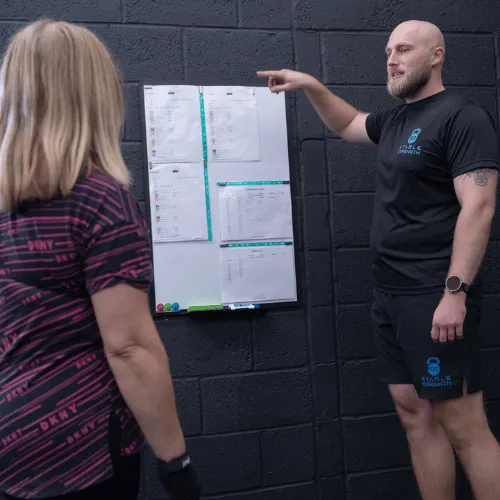
Small-group coaching makes habit change easier by providing accountability, micro-goal setting and regular review. Stable Strength runs small groups with the same coach each session and a maximum of four clients, combining personalised strength programming with habit coaching. Try a free taster session and use the 30-day results guarantee to see whether the approach fits your life before committing.
Putting it together: quick checklist and next steps
Use this short checklist to get started and then measure progress for four weeks so you leave the month with clear wins. Keep the checklist visible and review it weekly to adjust load, frequency or recovery based on how you feel.
Get medical clearance if you have recent fractures, known heart disease, uncontrolled conditions, or a fall in the last year.
Pick three compound strength moves and schedule 2–3 sessions per week focused on progressive overload.
Add about 150 minutes of moderate cardio across the week and include short daily walks (10 minutes minimum).
Practice balance and mobility 2–3 times weekly with short daily stretches.
Track sessions, rate effort and review after four weeks to adjust load or frequency.
You don’t need a gym to start. Minimal gear such as adjustable dumbbells, resistance bands and a sturdy chair cover most needs, while a bike or pool provides low-impact cardio options. For practical, clinic-based tips on how to exercise effectively in perimenopause and menopause, see further guidance from clinical services. Pause and consult a GP or physiotherapist before starting high-intensity or high-impact work if you have recent vertebral fractures, uncontrolled hypertension, known heart disease or a recent fall.
Final steps for confident menopause exercise
Menopause changes how your body responds to training, but the approach is clear and actionable. Prioritise strength to protect muscle and bone, then layer in steady cardio, balance work and targeted mobility so your time delivers results. Commit to two to three resistance sessions per week.


